Natural stone tile cleaning: safe daily care and stain fixes
Clean natural stone tiles with a pH-neutral cleaner, a soft mop or cloth, prompt blotting of spills, and periodic resealing. That combination handles the vast majority of everyday marks and keeps the surface from etching or dulling over time.
If something has just spilled on your floor or benchtop, act in this order:
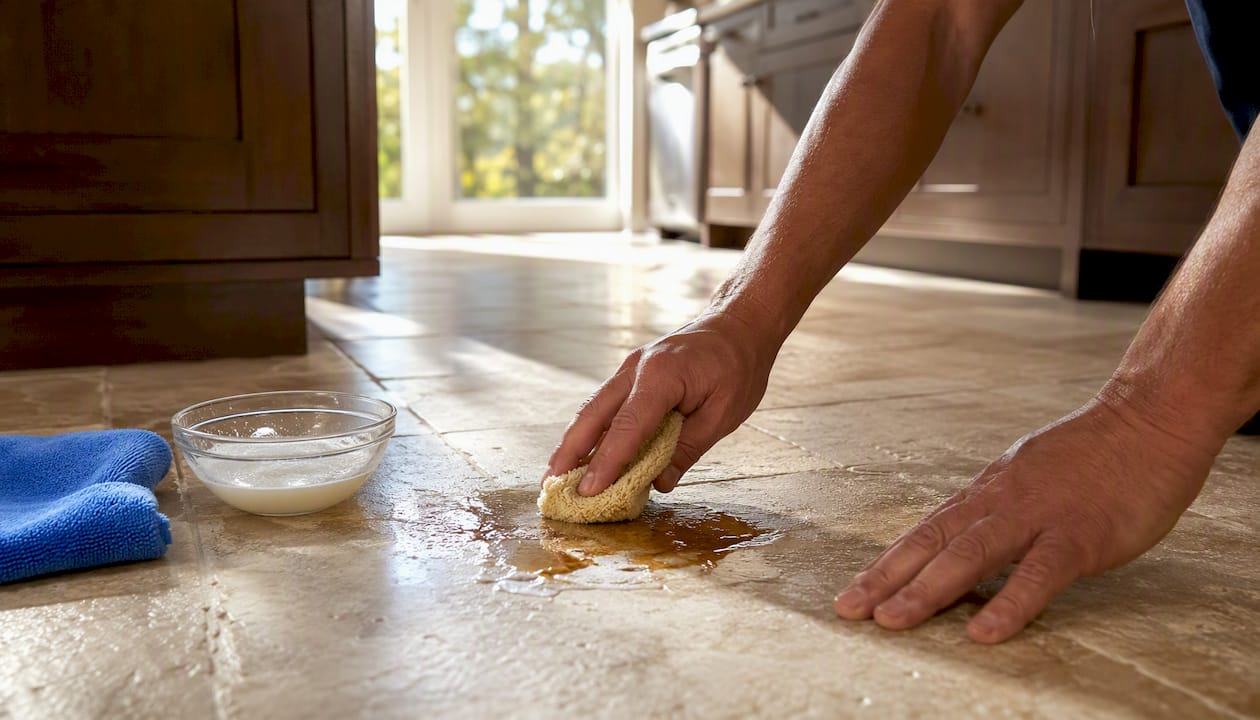
- Blot the spill immediately with a paper towel. Don’t wipe. Wiping spreads it.
- Lift any solid residue with a plastic scraper instead of a metal one.
- Clean the spot with a pH-neutral stone cleaner and a soft cloth.
- Rinse with plain water and buff dry with a clean microfibre cloth.
- Check back in a day for any dull or etched mark and note it for later treatment.
Never mix bleach and ammonia. The combination produces a toxic gas, and it’s one of the most common accidental hazards in home cleaning cupboards. Keep them stored well apart, and never combine cleaning products without checking the label first.
Key Takeaways
Natural stone tile cleaning succeeds when you match a pH-neutral cleaner and gentle tools to your specific stone type, blot spills immediately, and reseal on a schedule tied to your stone’s porosity.
| Point | Details |
|---|---|
| Identify your stone first | Calcareous stone (marble, limestone, travertine) etches with acid; siliceous stone (granite, quartzite, slate) tolerates more but still scratches. |
| Clean little and often | Dust daily in high traffic areas, damp mop two to three times weekly, and squeegee shower stone after every use. |
| Match stain treatment to stain type | Oil, organic, metal, and biological stains each need a different product and dwell time, with poultices for deep or old marks. |
| Never mix bleach and ammonia | The combination produces a toxic gas; avoid vinegar, lemon, and scouring powders on stone entirely. |
| Reseal based on a water test | If water soaks in within a few minutes instead of beading, it’s time to reseal following the product’s TDS. |
| Call in professionals for deep grime or failed sealer | Our tile and grout steam cleaning service handles deep extraction, stain removal, and sealer reapplication with insured staff. |
Table of Contents
- What is natural stone tile cleaning and why does it need special care?
- How do you identify your stone type before cleaning it?
- How often should you clean natural stone floors?
- How do you remove stains from natural stone without damaging it?
- What should you never use to clean natural stone?
- Does sealing stone tiles actually prevent damage?
- [Which tools and products are actually safe for stone? See our best tips to clean your beautiful interior doors for home-care insights on safe cleaning practices.](#which-tools-and-products-are-actually-safe-for-stone-see-our-best-tips-to-clean-your-beautiful-interior-doorshttpsonedaydoorsandclosetscomblogfeaturedwhat-is-the-best-thing-to-clean-interior-doors-with-for-home-care-insights-on-safe-cleaning-practices)
- When should you call a professional stone restorer?
- Sources
What is natural stone tile cleaning and why does it need special care?
Natural stone tile cleaning is fundamentally different from cleaning ceramic or porcelain, because stone is a reactive, porous material rather than an inert manufactured surface. Marble, limestone, and travertine will visibly etch, dull, or discolour when exposed to the wrong chemistry. Granite and slate are tougher but not indestructible.
This is the core reason generic supermarket cleaners cause problems: they’re formulated for surfaces that don’t react to acids. Stone does. The Natural Stone Institute recommends a neutral cleaner, stone soap, or a mild liquid dishwashing detergent diluted in warm water, followed by a thorough rinse and dry with a soft cloth, as the baseline for any stone surface, indoors or out.
How do you identify your stone type before cleaning it?
Split your stone into two families first: calcareous and siliceous. Marble, limestone, and travertine are calcareous, built largely from calcium carbonate, and they’re sensitive to acids of any kind, including vinegar and lemon juice. Granite, quartzite, and slate are siliceous, quartz-based, and far more chemically tolerant, though still scratchable.
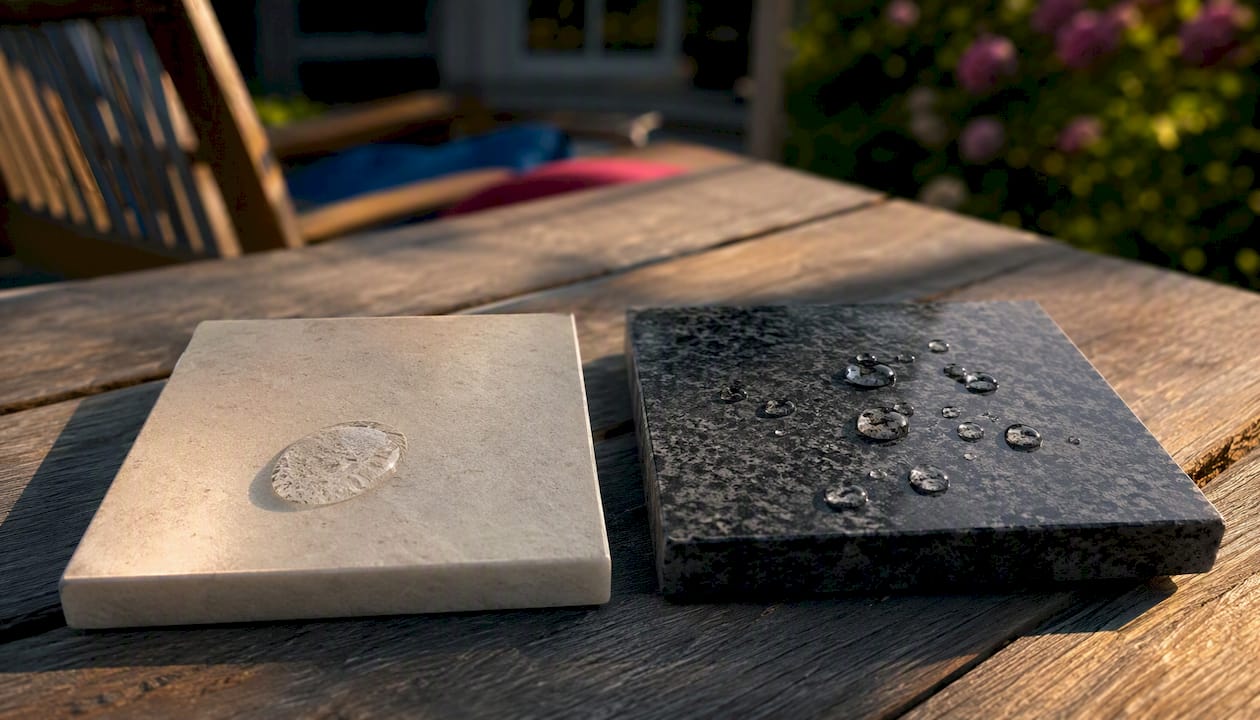
Finish matters just as much as mineral type. Polished stone shows etch marks as dull grey patches almost immediately. Honed stone (matte, no shine) hides light etching better but shows scratches and grit wear more readily. Textured or tumbled finishes trap dirt in their surface pits, so they need more frequent dusting to stop grit acting like sandpaper underfoot.
Not sure what you’ve got? Do a water drop test on a small area: if water beads up, the stone still has some sealer protection; if it soaks in and darkens within a couple of minutes, it’s due for resealing. Check with your installer or the manufacturer’s Technical Data Sheet if you’re still unsure of the exact stone name, since some engineered and natural-look products need different treatment altogether.
Pro Tip: Keep a photo of your tile box, invoice, or a spare offcut. It’s the fastest way to confirm the exact stone and finish months or years later when you’ve forgotten the details.
How often should you clean natural stone floors?
Dust daily in high-traffic areas, damp mop two to three times a week, and squeegee shower stone after every use. That schedule stops grit from scratching the surface and stops soap film from building up in wet areas.
The routine itself is simple:
- Dry dust or dry mop first, using a clean microfibre head rather than a treated dust mop, which can leave an oily residue on stone.
- Mix a pH-neutral stone cleaner at the diluted strength on the label. Stronger isn’t better. Over-concentrating the product is one of the most common causes of the hazy film homeowners mistake for permanent damage, according to MAPEI’s UltraCare guidance on natural stone care.
- Mop in sections, working the solution gently with a soft mop head.
- Rinse with clean water in a separate bucket. Reusing dirty rinse water just redeposits grime.
- Dry immediately with a clean towel or microfibre cloth to prevent water spots.
Kitchens and entries need this two to three times weekly given foot traffic and cooking spills. Bathrooms need daily squeegeeing on shower walls and floors, plus a full mop weekly. Low-traffic areas like formal lounges can often stretch to a weekly dust and fortnightly mop.
Doormats at every entry, felt pads under furniture legs, and coasters under plant pots and drink glasses prevent a huge share of the scratches and ring marks that otherwise end up needing professional attention.
How do you remove stains from natural stone without damaging it?
Identify the stain type before you touch it, because the wrong treatment can set a stain permanently or etch the surrounding stone. The Natural Stone Institute breaks most household stains into a handful of categories, each with a different fix.
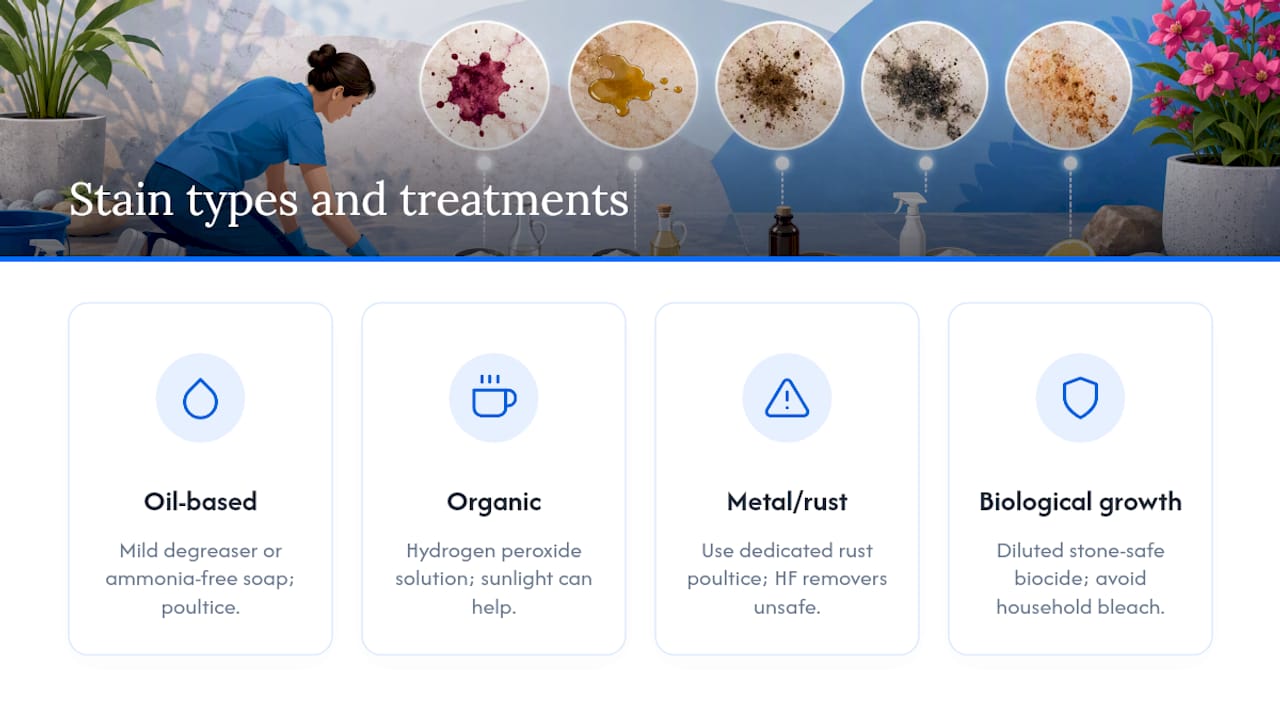
Oil-based stains (cooking oil, grease, cosmetics) darken the stone rather than discolouring it. A mild degreaser or ammonia-free dish soap applied and left to dwell for several minutes, then rinsed, usually shifts fresh marks. Older oil stains generally need a poultice.
Organic stains (coffee, tea, wine, fruit, leaves) often lift with a hydrogen peroxide solution left to sit, then rinsed and dried. Direct sunlight can help bleach a light residual mark on light-coloured stone.
Metal and rust stains are the hardest. Never use a commercial rust remover containing hydrofluoric acid, as it attacks the silicates in stone. A dedicated rust poultice is the safer route, and even then, some rust staining is permanent.
Biological growth (mould, mildew, algae on outdoor stone) responds to a diluted, stone-safe biocide rather than household bleach.
Ink and paint need a solvent-based poultice matched to the stain, applied by dwell time rather than scrubbing.
To make a poultice: mix an absorbent poultice powder with the appropriate liquid (water, mineral spirits, or peroxide, depending on the stain) into a paste roughly the thickness of peanut butter. Spread it about 6mm thick over the stain, extending slightly past its edges, cover with plastic wrap, and tape the edges down. Leave it for 24 to 48 hours to dry out fully, then scrape it off gently and rinse.
Repeated applications may be necessary for stubborn or old stains, and some deep or metal stains may be permanent. Setting realistic expectations before you start saves a lot of frustration.
Pro Tip: Always test any stain treatment, poultice included, on a hidden offcut or inconspicuous corner first. Stone reacts differently batch to batch, even within the same quarry.
What should you never use to clean natural stone?
A short list of products causes most of the avoidable damage homeowners see:
- Vinegar, lemon juice, and other acidic cleaners etch calcareous stone almost on contact, leaving a permanent dull patch.
- Bleach can discolour stone and strip sealer, and it reacts dangerously with ammonia-based products.
- Ammonia-based glass or all-purpose cleaners wear down sealer over repeated use and can dull polished finishes.
- Scouring powders and steel wool scratch polished surfaces permanently, no matter how gently you think you’re rubbing.
- Rust removers containing hydrofluoric acid chemically attack the silicates in granite and quartzite, not just surface stains.
- Steam cleaners can force moisture into grout lines and under marginal sealer, sometimes exceeding what the sealer or substrate can handle.
Bleach and ammonia should never be combined under any circumstance. The Marble Institute’s cleaning guidance flags this as a genuine toxic gas risk, not just a cleaning caveat.
Does sealing stone tiles actually prevent damage?
Sealing slows how fast liquid soaks into stone. It doesn’t prevent etching, and it won’t stop a chemical reaction from an acidic spill. What it buys you is time, generally minutes rather than seconds, to notice a spill and wipe it up before it stains.
There are two main sealer families. Penetrating (impregnating) sealers sit inside the stone’s pores and repel liquid without changing the surface look, typically lasting from one to several years depending on stone porosity and foot traffic. Enhancing sealers do the same job but also deepen colour and add a slight sheen, more common on darker stone or outdoor pavers.
Test whether you need a reseal with the same water drop method used for identification: if water soaks in within two to five minutes instead of beading, protection has worn off. Dense granite might go years between reseals; porous travertine or limestone in a wet bathroom might need it annually.
Sealers slow absorption but do not prevent etching, and they need to be applied strictly according to the product’s own Technical Data Sheet.
Pro Tip: Always clean the stone thoroughly and let it dry completely before resealing. Sealing over old soap film or dust traps that residue under the new coat permanently.
Which tools and products are actually safe for stone? See our best tips to clean your beautiful interior doors for home-care insights on safe cleaning practices.
Stock a small, dedicated kit rather than reaching for whatever’s under the sink:
- A microfibre flat mop for daily and weekly cleaning
- A soft-bristle brush for grout lines and textured finishes
- White absorbent cloths (colour can transfer from dyed cloths onto light stone)
- A plastic scraper for lifting dried spills
- A spray bottle for spot treatment
- A separate bucket for rinse water, kept apart from your wash bucket
For products, look for pH-neutral stone cleaners, a dedicated heavy-duty degreaser for kitchen stone, poultice powder for deep stains, and a penetrating or enhancing sealer matched to your stone type. Manufacturer lines such as STONETECH (part of the LATICRETE range) and MAPEI’s UltraCare range are worth checking against their own TDS before buying, since dilution rates and suitable stone types vary by product. Buy from a stone specialist or tile supplier rather than a general hardware aisle, and always test on an offcut first.
When should you call a professional stone restorer?
Call a professional when you’re dealing with an old or unidentified stain, widespread etching across a polished floor, cracked or lifting tiles, or a sealer that’s failed across a large area. DIY poulticing and light resealing cover most household situations, but honing, repolishing, and structural repair need equipment most homes don’t have.
A stone restoration contractor typically offers deep cleaning and extraction, professional-grade poultice work, honing and repolishing to remove ingrained etching, full sealer stripping and reapplication, and a structural check for cracked grout or shifting tiles.
Before booking, ask about their experience with your exact stone type, whether they follow the product TDS and SDS for the chemicals they use, proof of insurance, whether their method is wet or dry (dust extraction matters indoors), and what outcome they can realistically guarantee.
Pro Tip: A reputable contractor will always test a treatment on a small area before working the whole floor. If they skip that step, ask why.
Why professional care still matters after good routine habits
Good daily habits handle most of what stone throws at you, but etched marble, years of built-up grout grime, or a sealer that’s failed across a whole kitchen floor need equipment and product knowledge beyond a spray bottle and a soft cloth. Our trained, insured teams see these patterns across hundreds of Melbourne homes and know which product and method actually fixes them.
How we can help with your stone tile care
Routine upkeep is on you, and this guide gives you what you need for that. Deep grime, stubborn stains, and sealer that’s past its best are where a professional visit earns its keep, particularly on kitchen and bathroom floors that see daily traffic and moisture. Our tile and grout steam cleaning services cover exactly this: deep extraction cleaning, stain treatment, and sealer reapplication for natural stone tile and grout, carried out by trained and insured staff using eco-friendly methods.

If your floors haven’t had a proper deep clean in a while, or you’ve got a stain you haven’t been able to shift with a poultice, book an inspection and we’ll give you a straight assessment of what it’ll take, no pressure, no hard sell. You can also look at our broader tile clean services if grout discolouration across the whole floor is the bigger issue.
Sources
- Natural Stone Institute – Learn About Cleaning Products for Natural Stone
- Stone and Tile Care (LATICRETE / STONETECH technical document)
- How to clean, maintain and care for natural‑stone tile (MAPEI UltraCare guidance)
- Natural Stone care and cleaning guide (NTPavers / industry guidance)
- Marble Institute of America (MIA) stone cleaning guide (InspectApedia copy)
