Blood stain on carpet: quick steps for removal
Fresh blood on carpet? Blot immediately with a cold, damp cloth. Dried stain? Rehydrate with cold water first, then apply an enzyme protein-stain cleaner or test 3% hydrogen peroxide on a hidden spot. Those two rules cover most situations.
Blood is a protein stain. Heat denatures those proteins and bonds them permanently to the fibres, which is why hot water turns a manageable spill into a near-permanent mark. Cold water keeps the proteins loose so you can lift them out. The same logic rules out steam irons, hair dryers, and warm rinse water at every stage.
Pro Tip: The first 15 minutes are your best window. Fast blotting with cold water alone can remove a fresh stain entirely, before you need any chemistry at all.
Before you touch the stain, a quick safety note:
- Wear disposable gloves for any significant spill — blood is classified as potentially pathogenic.
- Never use hot water, bleach, or vigorous scrubbing at any point.
- Do not mix cleaning chemicals, especially ammonia and bleach together.
- Test any new product on an inconspicuous area before applying it to the stain.
Table of Contents
- What supplies do you need to remove blood from carpet?
- How do you remove a fresh blood stain from carpet?
- How do you treat a dried or set blood stain?
- How should you handle wool, natural fibres, and antique rugs?
- Why does the stain keep coming back after cleaning?
- When should you call a carpet-cleaning professional?
- Key takeaways
- The part most guides skip
- Carpetsteam Melbourne: when DIY has done its job
- Selected references and further reading
What supplies do you need to remove blood from carpet?
Gather these before you start. Having them within reach means you spend the critical first minutes blotting, not searching cupboards.
Household items
| Item | Purpose |
|---|---|
| White absorbent cloths or paper towels | Blotting without dye transfer |
| Clean spray bottle filled with cold water | Controlled application |
| Disposable gloves | Personal protection |
| Soft-bristle brush (e.g. nail brush) | Loosening dried crust only |
| Clean microfibre towels | Final blotting and drying |
Cleaning agents
- 3% hydrogen peroxide — oxidises the iron pigment in blood; available at supermarkets and pharmacies. Test on a hidden area first because it can bleach darker dyes.
- Enzyme protein-stain cleaner (labelled for carpets) — digests blood proteins at a molecular level; sold at hardware stores, carpet retailers, and online.
- Mild dishwashing liquid (neutral pH) — a gentle first step for fresh stains; one teaspoon in half a pint of cold water is the standard mix.
- Salt or cornflour — absorbs fresh liquid before it sets; salt works well as an initial draw before moving to enzyme or peroxide.
Enzyme cleaners are the most reliable option for protein stains and are worth keeping in the house. The science behind enzyme treatment explains why they outperform general-purpose detergents on biological stains.
How do you remove a fresh blood stain from carpet?
Work through these steps in order. Speed matters more than the specific product at this stage.
- Attend to any first-aid need first. The carpet can wait thirty seconds.
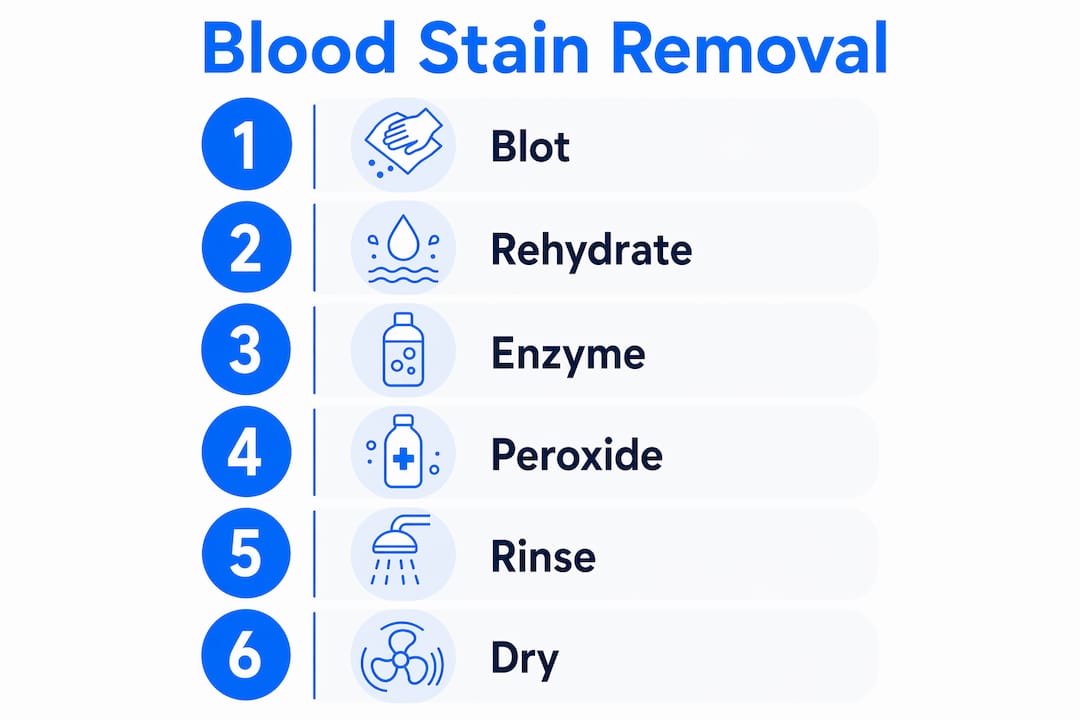
- Blot excess blood. Press a white cloth firmly onto the stain. Lift straight up; do not drag. Replace the cloth as it picks up colour.
- Apply cold water. Lightly spray or dab cold water onto the stain. Never pour — overwetting pushes the stain deeper.
- Blot from the outside edge toward the centre. Working inward stops the stain spreading. Keep blotting with clean sections of cloth until no more colour transfers.
- If colour remains, apply a mild dish-soap solution. One teaspoon of neutral dishwashing liquid in half a pint of cold water. Dab, blot, repeat.
- Move to an enzyme cleaner if the stain persists. Apply per the label, allow the full dwell time, then blot and rinse with cold water.
- Rinse and dry. Blot up as much moisture as possible, then stack several dry towels over the area and press down firmly. Allow to air-dry away from direct heat.
Avoid these at every step:
- Rubbing or scrubbing — scrubbing pushes blood deeper into the pile and frays the fibres.
- Hot water or a warm cloth.
- Mixing ammonia-based products with bleach.
How do you treat a dried or set blood stain?
Dried blood needs a different approach. The proteins have already started to bond, so you need to rehydrate them before any cleaner can work.
Break up and vacuum the crust
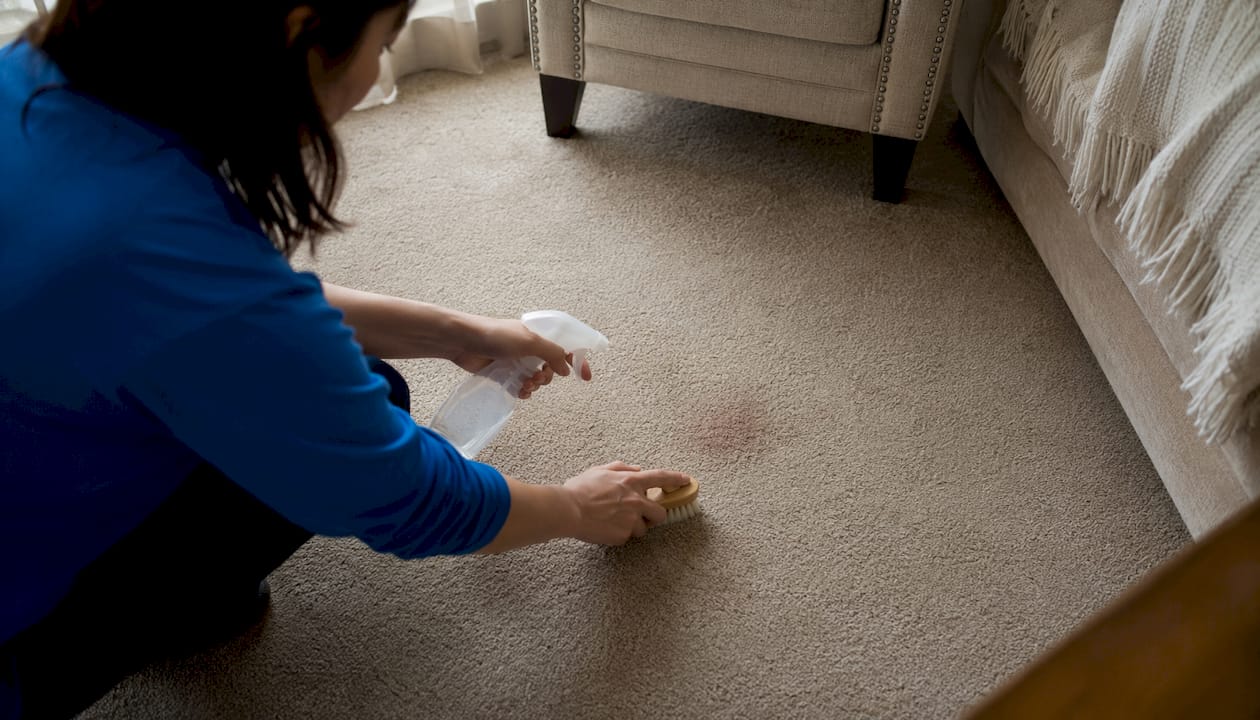
Gently work the dried residue loose with a soft-bristle brush, then vacuum thoroughly. Removing the surface crust first means your cleaner reaches the stain rather than sitting on top of dried debris.
Rehydrate with cold water
Lightly dampen the stained area with cold water and let it soak for 10 minutes. You are softening the proteins, not flooding the backing. Blot up any excess before moving on.
Enzyme dwell
Apply an enzyme protein-stain cleaner directly to the damp area. Cover it loosely with a cloth to slow evaporation, and allow the full dwell time stated on the label. Patience here does more work than any amount of scrubbing. Blot, do not rub, when the time is up.
Peroxide test (if enzyme alone is not enough)
Apply a small amount of 3% hydrogen peroxide to a hidden spot first. If the dye holds, apply it to the stain. It will fizz as it reacts with the blood proteins. Let the reaction finish, then blot thoroughly and rinse with cold water. Repeat if needed.
Pro Tip: If the carpet is dark or the dye looks unstable during the patch test, stop. Peroxide bleaching is irreversible. Stick to enzyme-only cycles or call a professional.
Rinse and dry
Rinse with cold water, blot dry, and use the weighted-towel method: stack several dry towels over the damp area and place a heavy book or pot on top. Leave for an hour. This draws residual moisture up rather than letting it wick back from the backing.
How should you handle wool, natural fibres, and antique rugs?
Wool and natural-fibre rugs need a more cautious approach than synthetic carpet. The stakes are higher because mistakes can be permanent.
| Fibre type | Peroxide safe? | Enzyme cleaner | Recommended action |
|---|---|---|---|
| Synthetic (nylon, polyester) | Yes, after patch test | Yes | Follow standard steps above |
| Wool | No | Wool-safe enzyme only | Patch test every product; avoid peroxide |
| Natural fibre (jute, sisal) | No | Avoid overwetting | Minimal moisture; blot only |
| Antique / hand-knotted rug | No | Professional only | Stop DIY; call a specialist |
Peroxide and many proprietary cleaners can cause colour loss and fibre damage on wool. The IICRC advises testing and avoiding peroxide on wool without specialist guidance. For antique or hand-knotted rugs where the dye or fibre origin is unknown, the risk of permanent damage from DIY treatment is simply too high.
Pro Tip: Photograph the stain and the rug label before you do anything. If you end up booking a professional, those photos help the technician assess the situation before arriving and may save time on the day.
Why does the stain keep coming back after cleaning?
A stain that reappears as the carpet dries is almost always wicking. Dissolved blood particles in the backing migrate upward as moisture evaporates, leaving a ghost mark on the surface.
Common reasons a stain resists treatment or returns:
- Heat was applied at some point, setting the proteins.
- Scrubbing drove the stain into the backing.
- The cleaner was not rinsed out thoroughly, attracting fresh soil.
- Dwell time was too short for the enzyme cleaner to work.
Diagnosing the problem:
- If the stain reappears after drying, suspect wicking from the backing.
- If the carpet looks lighter around the treated area, peroxide has bleached the dye.
- If the area feels sticky, residual detergent is attracting dirt.
Practical fixes:
- Repeat the enzyme cycle with the full labelled dwell time and a thorough cold-water rinse.
- Use the weighted-towel method after each treatment to pull moisture up rather than letting it settle back down.
- For sticky residue, rinse with plain cold water and blot repeatedly until the area feels clean.
If the stain returns after two or three full enzyme cycles, stop. Continued DIY risks setting the stain further. This is the point to call a professional with extraction equipment. For context on common move-out cleaning mistakes, scrubbing a stubborn stain instead of calling a pro early is consistently listed as one of the costliest errors renters make.
When should you call a carpet-cleaning professional?
Some situations are beyond what household products can fix. Knowing when to stop saves the carpet.
Call a professional when:
- The stain covers a large area or has soaked through to the backing.
- The stain has been heat-set (hot water was used, or a dryer was run nearby).
- The stain reappears after two or more treatment cycles.
- The carpet is wool, antique, or high-value.
- The stain is near a seam or the carpet backing is visible.
- IICRC guidance classifies larger blood spills as potentially pathogenic, recommending certified technicians for those incidents.
What professionals actually do
A trained technician starts with a colourfastness assessment, then applies enzyme pre-treatments suited to the fibre type. Professional extraction machines remove dissolved stain particles from the backing, which is the step that prevents wicking from recurring. For wool or antique rugs, low-heat or cold extraction with specialist chemistry is used instead of standard hot-water extraction.
Pro Tip: Before you book, take a photo of the stain and note the carpet fibre type (check the manufacturer’s label under a corner) and how long ago the spill happened. That information lets the technician arrive prepared rather than spending time assessing on the spot.
Carpetsteam Melbourne offers trained, insured technicians, modern extraction equipment, and eco-friendly enzymatic options, with same-day service where available. For end-of-lease situations where a blood stain could affect your bond, professional carpet cleaning is worth booking early.
Key takeaways
Cold water and blotting are the two highest-return actions for any blood stain on carpet; enzyme cleaners and professional extraction handle everything the DIY kit cannot.
| Point | Details |
|---|---|
| Blot, never scrub | Scrubbing drives blood deeper into the pile and frays fibres permanently. |
| Cold water only | Hot water denatures blood proteins and bonds them to fibres, often irreversibly. |
| Test hydrogen peroxide first | Always patch-test on a hidden area; peroxide can bleach dark or delicate dyes. |
| Give enzyme cleaners time | Full labelled dwell time digests proteins more effectively than repeated scrubbing. |
| Carpetsteam Melbourne for stubborn stains | Book professional extraction for large, heat-set, or recurring stains with same-day options available. |
The part most guides skip
Most blood-stain articles tell you what to use. Fewer tell you what actually goes wrong in practice. The single most destructive thing people do is reach for hot water because it feels more powerful. It is not. It cooks the stain in. The second most destructive thing is scrubbing, which frays the pile and pushes the stain into the backing where no household product can reach it.
The weighted-towel trick is the one step that separates a clean result from a ghost mark. After any wet treatment, stack dry towels over the area and weigh them down for at least an hour. Gravity and absorption do the work. Skipping this step is why stains reappear the next morning and why people assume the treatment failed when it actually worked, just incompletely.
One more thing: if you are planning to book a professional, photograph the stain before you treat it. Technicians can assess fibre type, stain age, and likely penetration depth from a clear photo. That saves time on the visit and sometimes changes which method they bring.
Carpetsteam Melbourne: when DIY has done its job
When blotting and enzyme cycles have not fully cleared the stain, or when the carpet is wool, antique, or covering a large area, the next step is professional extraction. That is exactly what Carpetsteam Melbourne is set up for.

Carpetsteam Melbourne’s trained, insured technicians use modern extraction equipment and eco-friendly enzymatic treatments to remove deep-set or recurring blood stains safely. Every job starts with a colourfastness assessment so the right chemistry is matched to your carpet’s fibre. Same-day bookings are available for urgent situations. The service extends to aged-care facilities, end-of-lease cleans, and specialist rug cleaning where stain protocols need to meet higher hygiene standards.
Before you call, take a photo of the stain, note the carpet type, and have an idea of how long ago the spill happened. Then book your clean directly through the website for a fast, no-fuss quote.
Selected references and further reading
The methods in this guide draw on the following sources. Each is worth bookmarking for ongoing carpet care.
- IICRC Consumer Floor and Furnishings Care Information — Carpet Topics: Industry-standard guidance on PPE, safe spotting procedures, and when to refer to a certified technician.
- University of Georgia Extension — Remove Stains From Blood, Textiles: Step-by-step fibre-specific instructions from an academic extension service, including cautions on ammonia and wool.
- Blood Stain Removal From Carpet: A Pro Technician Guide: Practitioner-level detail on enzyme dwell times, extraction, and wicking prevention.
- How to Clean Carpet Stains — DG Floors: Covers the protein-stain chemistry behind cold-water-first rules and the scrubbing mistake.
- How to Get Blood Out of Carpet — Reader’s Digest: Consumer-facing overview of six methods including salt, peroxide, and enzyme options with expert input.
- How to Remove Common Stains From Carpet — Morris Carpet Care: Practical timing guidance and the 15-minute window for fresh spills.
- How to Remove Blood Stains — Healthline: Includes the University of Georgia’s recommended detergent-and-ammonia method for carpets with absorbent-pad drying.
- Carpet Steam Cleaning Guide Melbourne: Overview of professional extraction methods and their advantages over DIY for deep-set stains.
Note: Always pretest any cleaning agent on an inconspicuous area before applying it to the stain, and follow the product label’s dwell time instructions precisely. This guide is general information; for high-value, antique, or heavily soiled carpets, confirm the appropriate method with a qualified cleaning professional before proceeding.
